
Structured Data for SEO: Complete Guide to Schema Markup, Rich Results, and AI Citations


Table of Contents +
- What Is Structured Data for SEO?
- Why Does Structured Data Matter for Search and AI Citations?
- Myth: Does Schema Markup Improve Your Search Rankings?
- How Does Schema Markup Bridge Humans and Machines?
- What Are the Core Types of Schema Markup for Publishers?
- How Should You Implement Schema Markup-Plugins, Generators, or Automation?
- How Do You Validate and Maintain Schema Markup Quality?
- Frequently Asked Questions
- References and Further Reading
Structured data for SEO won't rank you higher-but it unlocks rich results and AI citations. See what schema markup does and how to automate it.
Ask around and you'll hear the same thing: bolt schema markup onto your pages and watch your rankings climb. Structured data for SEO gets treated like a cheat code-a few lines of JSON-LD and Google supposedly pushes you up the results. It's one of the most repeated beliefs in the field, and it's quietly wrong.
The reality is more specific, and the gap costs teams real visibility. Schema markup isn't a lever you pull to rank higher. It's the layer that decides whether search engines and AI answer engines can read your content at all-whether you're eligible for rich results, and whether ChatGPT or Perplexity can lift your page into an answer. Get the belief wrong and you either skip markup entirely or bury your pages under fields that do nothing, while competitors quietly claim the citations you were eligible for.
What Is Structured Data for SEO?
Structured data for SEO is a standardized vocabulary-schema.org-that labels your content so machines understand what it means, not just how it looks. Instead of guessing that a date is a publication date, a search engine reads it as one. Three formats exist, but JSON-LD is the one that matters.
The distinction that trips people up is data versus presentation. Your visible page tells a human reader that "Dr. Anna Weber" wrote an article on March 3. Structured data tells a machine the same thing in an unambiguous format: this string is the author, this entity is a Person, this value is the datePublished. Presentation is for eyes; structured data is for parsers.
There are three ways to embed it-Microdata, RDFa, and JSON-LD. The first two weave markup directly into your HTML attributes, which means every layout change risks corrupting the data. JSON-LD schema markup sidesteps that entirely: it lives in a single script tag, separated from the content it describes. Google explicitly recommends it for exactly this reason-the separation keeps updating your markup from breaking your layout. For anyone publishing at scale through templates, that separation isn't a nicety; it's what makes markup safe to automate. We go deeper on the format decision in our guide to JSON-LD for SEO.
GetTraffic writes and publishes SEO content automatically - articles that build authority and drive organic traffic - start your free trial.
Why Does Structured Data Matter for Search and AI Citations?
Structured data matters because it unlocks two things content alone can't: eligibility for rich results in search, and citation in AI-generated answers. It won't rank you higher, but it makes your pages machine-readable-and machine-readability is now the price of entry for both Google's rich cards and AI answer engines.
On the search side, schema markup communicates the semantic meaning of your content to search engines, which lets Google build richer result cards-author, publication date, images, and other metadata pulled straight from your markup. Richer cards tend to earn more attention in the results, and the markup is what makes that enhanced display possible in the first place.
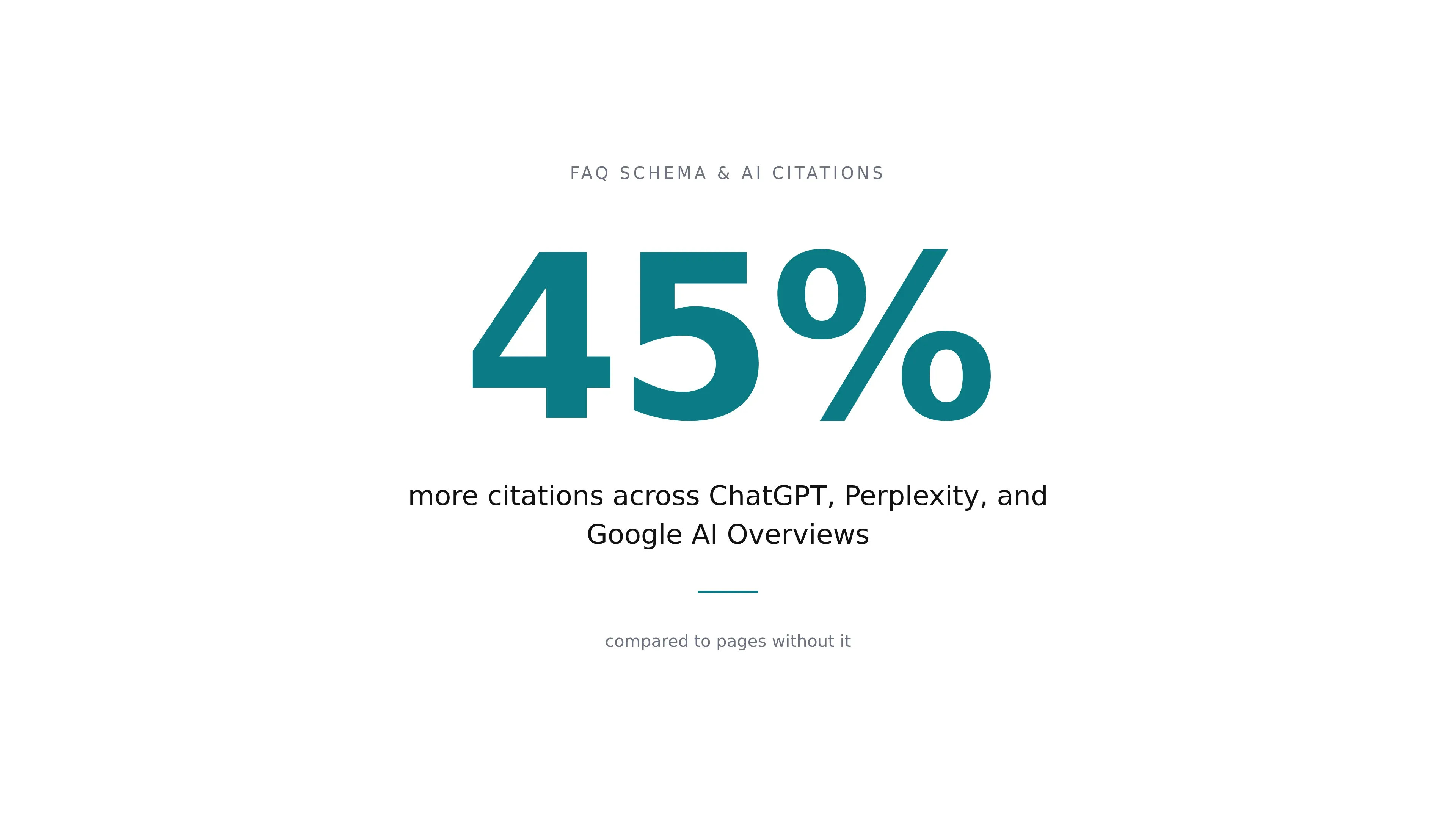
The AI side is where the stakes have shifted fastest. FAQ schema correlates with 45 percent more citations across ChatGPT, Perplexity, and Google AI Overviews compared to pages without it. Structured data is now one of five pillars of answer engine optimization-alongside entity recognition, authoritative sourcing, content structure, and intent-driven design. We break that correlation down in our deep dive on FAQPage schema and AI answer engine citations.
Google's March 2026 Core Update reinforced the trend by elevating the significance of entity schema-Organization and Person types that disambiguate who you are and what you're about. The signal is clear: schema is no longer optional plumbing. It's infrastructure for being found by both classic search and the AI layer stacked on top of it.
Myth: Does Schema Markup Improve Your Search Rankings?
No-schema markup does not improve your search rankings. This is the single most persistent myth in structured data. Markup functions as a verification and machine-readability layer, not a ranking factor. Weak content will not rank higher because you added markup; Google evaluates helpfulness, originality, and expertise independently of it.
The research is blunt about this. Overall page quality is the strong predictor of citation-not the presence of markup. Schema confirms relationships and entities that are already there in your prose; it doesn't manufacture authority the content lacks.
Here's the distinction worth internalizing. The claim "markup improves rankings" is false. The claim "markup enables rich result eligibility and AI citation eligibility" is true. Those are different mechanisms. One is a multiplier that doesn't exist; the other is a gate you have to pass through. Skip the gate and you're invisible in formats you'd otherwise qualify for-no matter how good the content is. Add markup to thin content and nothing happens, because there's nothing for the markup to verify.
How Does Schema Markup Bridge Humans and Machines?
Schema markup works as a translation layer: your visible page speaks to humans, while the JSON-LD speaks to parsers in a vocabulary they trust. Search engines use it to extract entities and relationships; AI systems use it to confirm who wrote what and how confidently they can cite you.
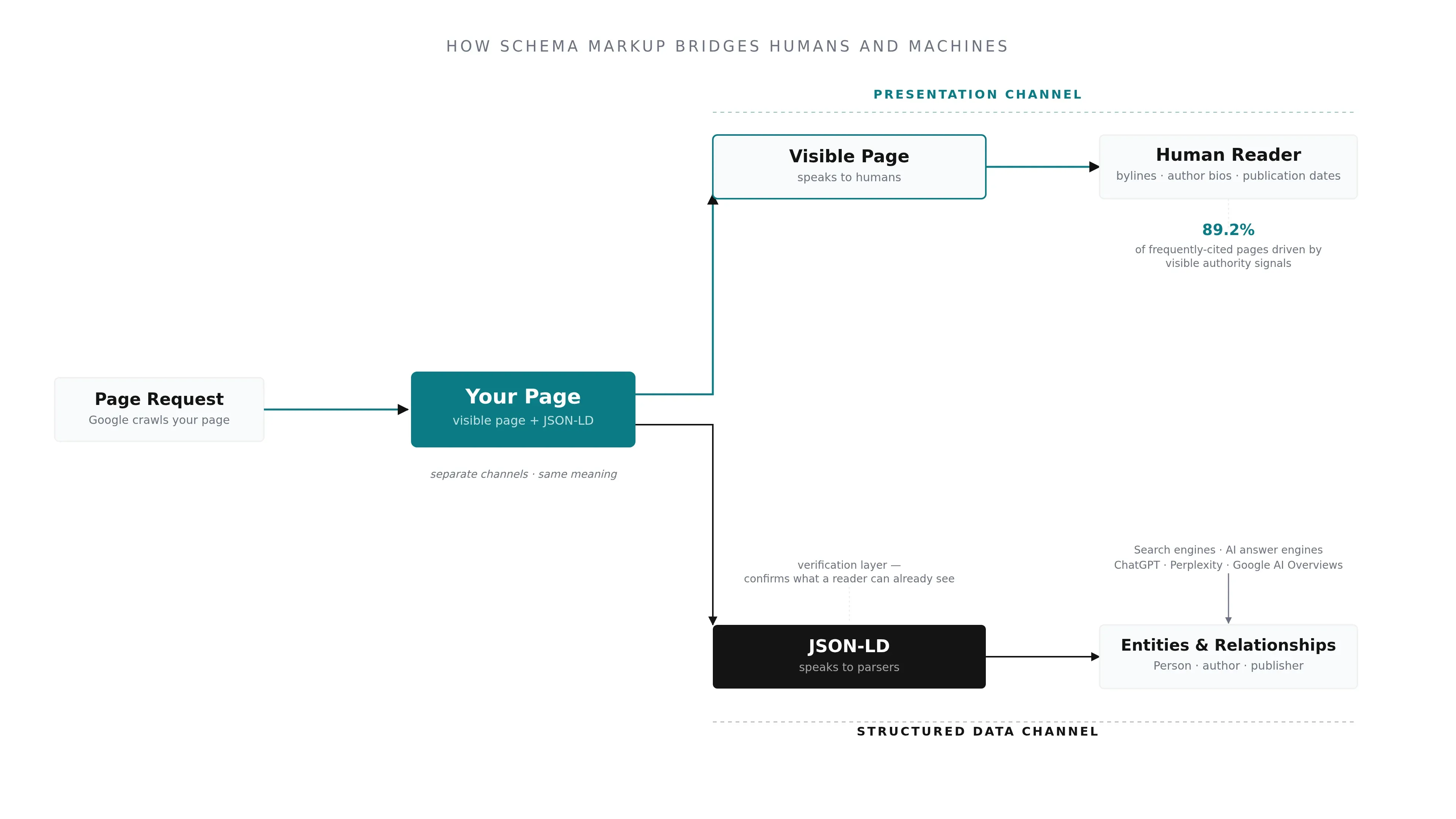
When Google crawls your page, it parses the JSON-LD to identify entities-this is a Person, this Person is the author, this Organization is the publisher-and the relationships between them. AI answer engines like ChatGPT, Perplexity, and Google AI Overviews do something similar to decide whether your page is a trustworthy source to quote.
But here's the part that reorders most people's priorities: visible authority signals-bylines, author bios, and publication dates rendered in the actual HTML-independently drive 89.2 percent of frequently-cited pages. Person schema with no matching visible bio contributes close to nothing on its own. The lesson isn't "skip the schema." It's that schema is the verification layer, not the source of truth. It confirms what a reader can already see. Put the byline and credentials on the page first; then let the markup vouch for them.
What Are the Core Types of Schema Markup for Publishers?
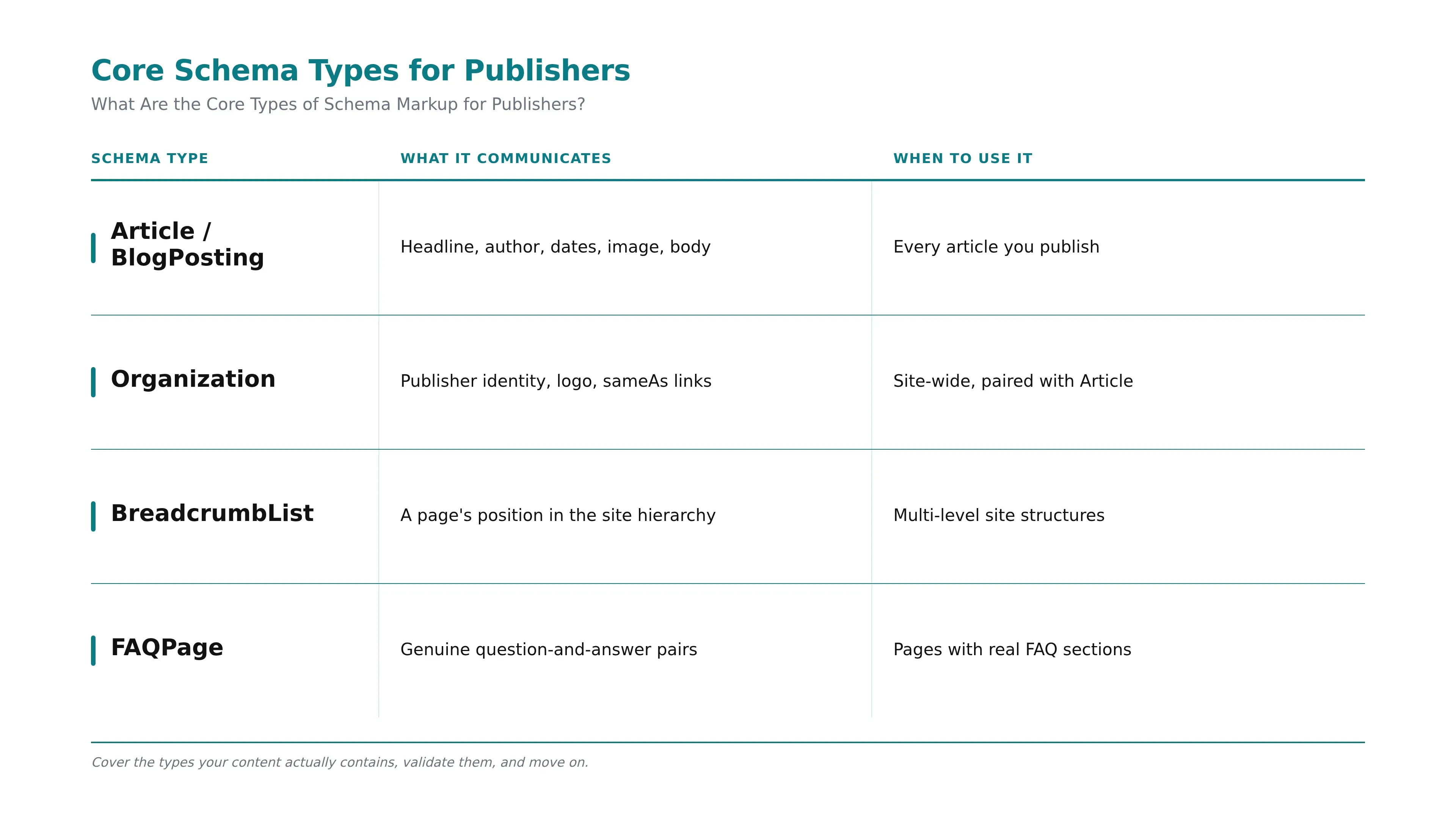
The core types of schema markup for article publishers are four: Article (or BlogPosting), Organization, BreadcrumbList, and FAQPage. Article describes the content itself, Organization establishes the publisher, BreadcrumbList communicates site structure, and FAQPage marks up genuine question-and-answer sections. Together they give machines a complete picture of a page.
Article schema and its subtypes carry the fields that matter most for eligibility: headline, description, image, datePublished, dateModified, author as a Person with a name, and articleBody. Pair it with Organization schema so machines know who published it. BlogPosting and NewsArticle are the subtypes you'll reach for most as a content publisher-our BlogPosting schema implementation guide covers the field-by-field detail.
BreadcrumbList communicates where a page sits in your site hierarchy; we walk through it in the BreadcrumbList schema guide. FAQPage marks up real question-and-answer sections-and it's worth noting that FAQ rich results no longer display for most non-government, non-health sites in search, so its value now sits in machine-readability for AI engines rather than SERP decoration.
| Schema type | What it communicates | When to use it |
|---|---|---|
| Article / BlogPosting | Headline, author, dates, image, body | Every article you publish |
| Organization | Publisher identity, logo, sameAs links | Site-wide, paired with Article |
| BreadcrumbList | A page's position in the site hierarchy | Multi-level site structures |
| FAQPage | Genuine question-and-answer pairs | Pages with real FAQ sections |
The temptation is to stack every type you can. Resist it-light, focused markup consistently outperforms heavy field-stuffing for AI citation, with pages carrying roughly 1 to 20 fields earning more citations than pages stuffed past 20. Cover the types your content actually contains, validate them, and move on. Our schema markup types checklist maps which types each article format needs.
SEO content that ranks, written and published for you
GetTraffic creates authority-building content clusters for your business. No writing, no freelancers, no content calendar. Agency-quality results at 91% less cost.
Start My Free TrialHow Should You Implement Schema Markup-Plugins, Generators, or Automation?
You have three ways to implement schema markup: CMS plugins, standalone generator tools, and platform-native automation. Plugins handle baseline types with almost no effort, generators give you a hand-built JSON-LD block to paste in, and native automation embeds validated markup at publish time-with no developer handoff required.
CMS plugins are the default entry point. Yoast SEO and Rank Math generate baseline Article, Organization, and BreadcrumbList markup automatically from the metadata you already fill in-title, author, date, featured image. They're excellent for standard cases and weak on advanced fields like knowsAbout or areaServed. Our comparison of Yoast, Rank Math, and custom JSON-LD lays out where each one stops.
A schema markup generator is the middle path: a standalone builder that outputs a JSON-LD block you paste into your template header. It gives you control the plugins don't, but it reintroduces a manual step per article-and a manual step per article is exactly what breaks at scale. We compare the leading structured data generator tools for content operations teams separately.
The third path is platform-native automation, and it's the one that changes the economics. When schema generation is built into the publishing workflow, valid markup is embedded before the article ever reaches your CMS-no post-publish developer handoff, no per-article copy-paste. This is where a content operations platform like GetTraffic fits: it structures each article for schema compliance and embeds Article, FAQ, and BreadcrumbList markup automatically, so coverage stays consistent across an entire topical authority cluster instead of degrading article by article. We detail the mechanics in how to automate schema in your CMS pipeline.
How Do You Validate and Maintain Schema Markup Quality?
Validate schema markup before you publish, because invalid markup is silently ignored-not flagged. Malformed JSON-LD costs you rich result eligibility and AI citation probability with no error message to warn you. Run every page through Google's Rich Results Test and the Schema.org Validator before it goes live, then monitor for drift.
The failure mode is quiet. Crawlers silently ignore invalid or malformed markup rather than telling you something's wrong, so a broken block can sit on a live page for months while you assume you're covered. That's what makes pre-publish validation non-negotiable.
Two free tools do the job. Google's Rich Results Test shows you whether a page qualifies for specific rich result types and flags blocking errors. The Schema.org Validator-a schema markup validator maintained by schema.org-checks your JSON-LD against the vocabulary definitions. Common errors that disqualify pages include missing required fields, wrong value types, and referencing entities that aren't defined on the page. Our guide to validating schema markup before publishing walks the full workflow.
Validation isn't a one-time event. Content drifts-dates go stale, authors change, templates get refactored-and markup drifts with it. The scalable answer is to move validation upstream, into the publishing workflow itself, so no article reaches your live index with markup that fails. Automated pre-publish checks turn validation from a manual chore you'll eventually skip into a gate that can't be bypassed.
The myth we opened with-that schema markup lifts rankings-falls apart on contact with the evidence. Structured data for SEO doesn't move you up the results. It decides whether you're eligible for rich results and whether AI answer engines can cite you at all. It verifies the authority your content already earns; it never manufactures authority that isn't there.
Which means the real question isn't whether to use schema. It's whether you can keep it consistent, valid, and complete across every article you publish-because manual implementation degrades the moment your content volume grows. That's the gap automation closes.
Frequently Asked Questions
Is schema markup a Google ranking factor?
No. Schema markup is not a ranking factor. Google evaluates content on helpfulness, originality, and E-E-A-T signals independently of whether markup is present. What schema does is make pages eligible for rich results and readable by AI answer engines. Adding markup to weak content won't lift its position-it only verifies signals that are already there in your prose and on your page.
What is the best format for schema markup?
JSON-LD is the recommended format, and Google says so explicitly. Unlike Microdata and RDFa, which embed markup inside your HTML attributes, JSON-LD lives in a separate script tag. That separation means updating your markup can't corrupt your page layout, and it's far easier to generate through templates at scale. For anyone publishing regularly, JSON-LD is the practical default.
Does FAQ schema still help now that FAQ rich results are gone?
Yes, but its value has shifted. FAQ rich results no longer display for most non-government, non-health sites in search. However, FAQPage schema still correlates with roughly 45 percent more citations across AI answer engines like ChatGPT, Perplexity, and Google AI Overviews. The payoff moved from SERP decoration to machine-readability-helping AI systems extract and cite your question-and-answer content.
How many schema fields should I include?
Fewer than you might think. Research shows pages with light markup of roughly 1 to 20 fields earn more AI citations than pages stuffed with 20-plus fields. Comprehensiveness isn't the goal; accuracy is. Cover the schema types your content actually contains, fill the required and recommended fields correctly, validate them, and stop there. Field-stuffing signals nothing useful to search engines or AI systems.
References and Further Reading
Get your business on page 1 of Google
Get your business found on Google - SEO content written and published automatically.
Start My Free Trial7-day free trial